
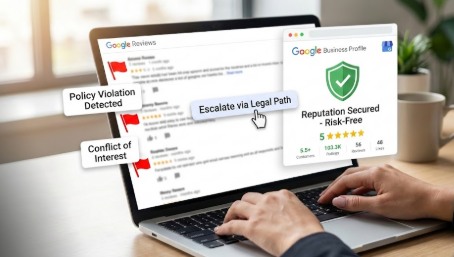
Learn how to report Google reviews that violate policy so you can protect your business without wasting time on tactics that do not work.
Negative Google reviews can hurt trust fast, especially when they are fake, abusive, or clearly against policy. Many business owners try to flag reviews randomly or respond emotionally, which rarely leads to removal.
The truth is simple. Google only removes reviews that break specific guidelines, and the process works best when you follow the correct reporting path with solid documentation.
This guide walks you through what actually works, what does not, and how to escalate when standard reporting fails.
What does it mean to remove a Google review?
Removing a Google review means getting it taken down by Google because it violates their content policies. It does not mean hiding it, pushing it down, or arguing with the reviewer.
Google will not remove reviews just because they are negative or feel unfair. A review must break a rule such as being fake, abusive, off topic, or posted by someone with a conflict of interest.
At a high level, valid removals are based on:
- Clear policy violations
- Proper reporting through Google tools
- Consistent follow up when needed
What Google review removal options actually exist?
There are only a few legitimate ways to deal with bad Google reviews. Understanding the difference saves time and frustration.
- Policy based reporting: Flagging reviews that violate Google’s guidelines
- Owner responses: Public replies that reduce damage when removal is not possible
- Escalation and appeals: Requesting manual review after rejection
- Professional assistance: Structured documentation and follow up when volume or complexity increases
Anything outside these paths is usually ineffective or risky.
Common Google review violations that qualify for removal
Google removes reviews based on content, not opinion. The most common violations include:
- Spam and fake reviews: Reviews from bots, competitors, or accounts with no real experience
- Off topic content: Political rants, personal disputes, or unrelated commentary
- Hate speech and harassment: Threats, slurs, or abusive language
- Conflict of interest: Reviews from employees, former staff, or competitors
- Illegal content: Claims involving crimes without evidence or court records
- Impersonation: Reviews written as if they are someone else
If a review fits one of these categories, you have a legitimate case.
How to report a Google review step by step
Follow this process carefully. Skipping steps often leads to automatic rejection.
- Flag the review in Google Maps or Search
Click the three dot menu next to the review and select “Report review.” Choose the most accurate violation category. - Document the violation
Take screenshots, note usernames, dates, and patterns. For example, multiple reviews from new accounts in a short time window. - Use the Google Business Profile dashboard
Reporting from inside your account gives Google more context and improves review accuracy. - Submit a review appeal if rejected
Google allows appeals for reviews you believe were wrongly denied. This step is often overlooked. - Track outcomes and follow up
Responses can take days or weeks. Keep records so you know when to escalate.
Tip: Always select the most specific policy violation. Vague categories reduce your chances.
Why many Google review removal attempts fail
Most failures happen for predictable reasons:
- The review does not violate policy
- The wrong violation category was selected
- No supporting documentation was provided
- Reports were submitted inconsistently or emotionally
- Multiple people flagged the same review incorrectly
Key Takeaway: Google enforces rules, not fairness.
When escalation makes sense
Escalation is appropriate when:
- A review clearly violates policy
- Initial reports were denied
- The review causes material harm to your business
- There is a pattern of abuse or fake activity
In these cases, businesses often look for structured help to manage documentation, appeals, and communication. Services that are able to remove Google reviews like Erase.com can clarify timelines, evidence requirements, and realistic outcomes without promising guaranteed removal.
What not to do when trying to remove Google reviews
Avoid these common mistakes:
- Buying fake positive reviews
- Threatening or harassing reviewers
- Asking friends or employees to flag reviews
- Submitting false legal claims
- Repeatedly flagging without new evidence
These actions can trigger penalties or even profile suspension.
How long does Google review removal take?
Timelines vary based on complexity:
- Simple spam removals: a few days to two weeks
- Appeals and escalations: two to six weeks
- Pattern abuse investigations: longer, depending on volume
There is no instant removal option, no matter what anyone claims.
Google review removal FAQs
Can Google remove a review just because it is false?
No. False opinions are allowed unless they break a specific policy rule.
Should I respond before trying removal?
Often yes. A calm, factual response protects your reputation while removal is pending.
Can lawyers remove Google reviews?
Lawyers can help in defamation cases, but Google still applies its own policies first.
Do removal services guarantee success?
No legitimate provider can guarantee removals. Outcomes depend on policy compliance.
Conclusion
Removing Google reviews is possible, but only when you follow the rules Google enforces. The most effective approach combines accurate reporting, proper documentation, patience, and escalation when warranted.
If reviews clearly violate policy and continue to cause harm, your next step is to assess whether structured reporting or professional assistance makes sense for your situation.
Clean reputations are built methodically, not through shortcuts.